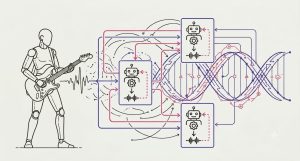
 In the world of live music, “looping” has long been a staple for solo performers. By recording a snippet of a melody or rhythm and playing it back on repeat, a single musician can build an entire wall of sound. However, traditional looping requires the performer to manually trigger every start and stop—a process that demands significant mental focus and precise footwork. The Multi-Agent Autonomous Looper (MAAL), a system primarily created by Vincenzo Madaghiele, aims to change that by turning the looper into an intelligent, co-creative partner.
What is the MAAL?
At its core, the MAAL is a rule-based co-improvisation system. Instead of waiting for a human to press a button, the system uses artificial “agents” to listen to the musician in real-time. Each agent is responsible for its own loop track, and they work together to decide which parts of a live performance are worth capturing and layering into an evolving musical structure. The system operates on what researchers call the “meso-level” of music. This means it doesn’t just listen to individual notes (micro-level) or the entire song (macro-level); it focuses on phrases and gestures lasting anywhere from 100 milliseconds to 8 seconds. By analyzing these segments, the agents can identify meaningful rhythmic patterns or melodic hooks to repeat.
How the “Brain” Works: Machine Listening and Rules
To make its decisions, the MAAL employs machine listening. It breaks down the musician’s sound into specific descriptors, such as rhythmic density, harmonic similarity, and timbral brightness. Each agent follows a specific set of rules to determine if a new segment of music fits the current vibe. For example, one agent might be programmed to only capture a loop if it is rhythmically different from what is already playing but harmonically similar. The system uses “and-logic,” meaning a segment is only looped if it satisfies every rule assigned to that specific agent. If multiple agents want the same piece of music, the one that find the segment most “compatible” wins the prize.
Personalizing the AI with Genetic Algorithms
One of the biggest challenges with autonomous music systems is making them “sound” like the artist using them. To solve this, the MAAL uses a genetic algorithm (GA) for personalization. A genetic algorithm is an optimization method inspired by the process of Darwinian evolution. Instead of a human manually fine-tuning dozens of complex mathematical thresholds, they simply provide the system with a “corpus”—a small collection of recordings where they have marked the moments they would have looped.
The GA then goes to work:
- Population: It starts with a random set of rule configurations.
- Simulation: It runs these rules against the musician’s recordings to see what the AI would have chosen.
- Fitness: It scores each configuration based on how closely it matches the musician’s original preferences.
- Evolution: The best-performing “parents” are kept, their “genes” (rules and thresholds) are combined and mutated, and a new generation of rules is born.
Through this iterative process, the MAAL “evolves” a personalized set of behaviors that align with a specific musician’s style and aesthetic.
Emergent Musical Structures
Because the agents are constantly listening to both the musician and each other, the MAAL exhibits emergent behavior. The music isn’t pre-programmed; it grows organically. The system can shift between states of stable equilibrium—where the loops complement each other perfectly—and moments of rapid change where the agents “search” for a new musical direction. By automating the mechanical task of recording and layering, the MAAL allows the musician to step into a new role: a manager or curator of the sound. The result is a unique co-creative dialogue where the human provides the raw material, and the AI helps shape the architecture of the performance.
Source Code
Demo Videos
Related Publications:
- Madaghiele, Vincenzo; Fasciani, Stefano; Kelkar, Tejaswinee & Erdem, Cagri (2026). Personalizing behaviors of the multi-agent autonomous looper with an annotated co-performance corpus. Organised Sound.
- Madaghiele, Vincenzo; Fasciani, Stefano; Kelkar, Tejaswinee & Erdem, Cagri (2025). MAAL: a multi-agent autonomous live looper for improvised co-creation of musical structures. Proceedings of International Conference on AI and Musical Creativity. AI Music Creativity (AIMC). doi: 10.5281/ZENODO.16946080.